

In short
Commercial heating services cover the maintenance, repair and improvement of the whole heating system in a commercial building, not just the boiler. Engineers look at heat generation, circulation, valves, pipework and controls together, because uneven or failed heating is often caused by a component away from where the symptoms appear.
What the work may involve
- Heating system maintenance and servicing
- Heating repairs and fault diagnosis
- Circulation and temperature-control problems
- Heating plant upgrades and replacements
- Heating efficiency assessments
- Planned maintenance programmes
Warning signs to report
- Some floors or zones warm while others stay cold
- Radiators or heat emitters hot at the top and cold at the bottom
- Heating that ignores time schedules or setpoints
- Noisy pipework, pumps or valves
- Rising energy use without a change in occupancy
How commercial heating systems work
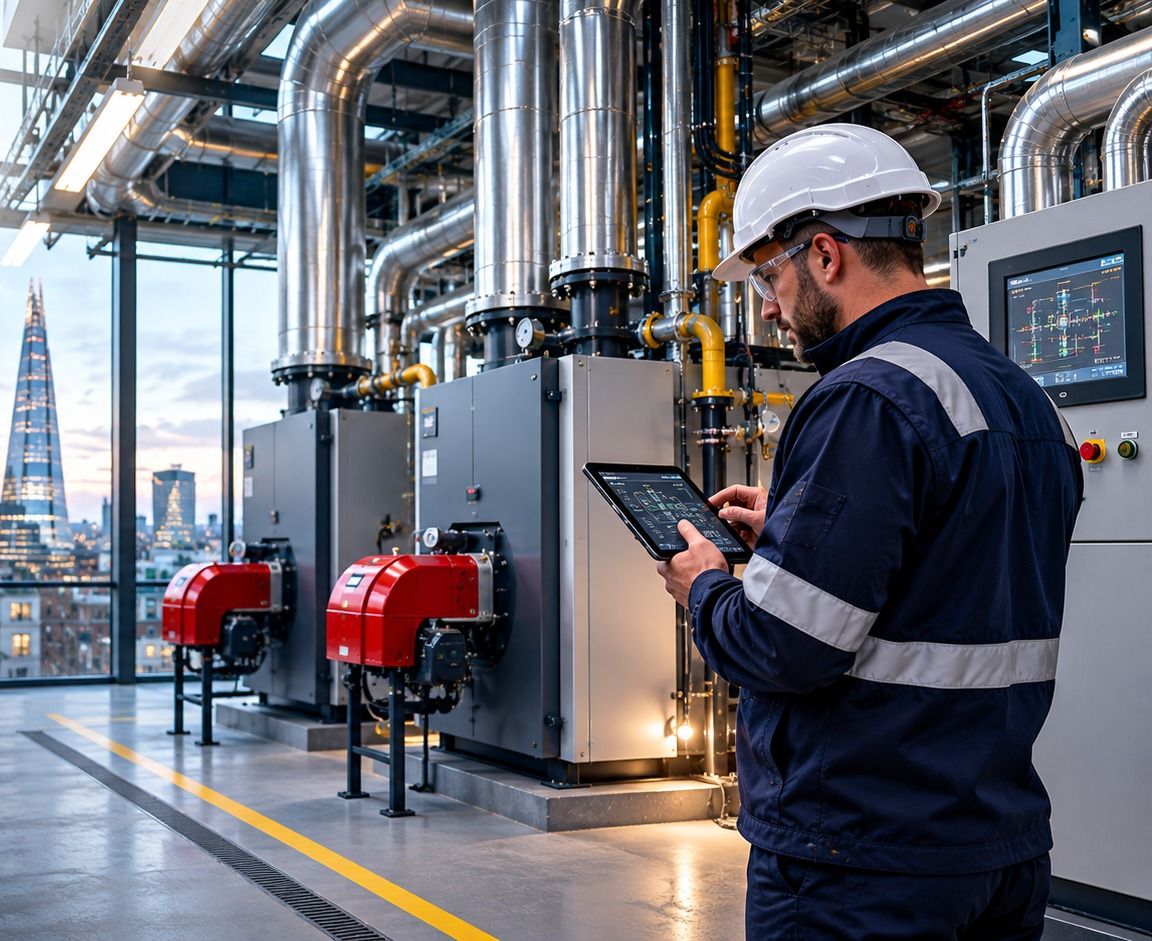
Most commercial heating systems have three parts: heat generation (boilers, heat pumps or district heat connections), distribution (pumps, pipework, valves and heat emitters), and control (time schedules, sensors, actuators and often a building management system). A fault in any one of these can look like a heating failure.
That is why heating work in commercial buildings should start with the system as a whole. Replacing a component where the symptom appears may not fix a problem caused elsewhere, such as a failed circulation pump or an incorrect control schedule.
Common commercial heating problems
- Uneven temperatures across floors or zones, often linked to circulation, balancing or valve faults
- Slow warm-up in the morning, which can relate to optimiser settings, pump performance or plant capacity
- Heating running outside occupied hours, usually a schedule or control issue
- Recurring boiler lockouts, which can be caused by the boiler, the controls, circulation or system pressure
- Noise and vibration from pumps, valves or air in the system
Planned maintenance and upgrades
A heating maintenance programme may combine boiler servicing with checks on pumps, valves, pressurisation, water condition and controls. When equipment is reaching the end of its life, engineers can help assess repair against replacement, considering the building’s demand, operating hours and the condition of connected plant.
Gas appliance work must only be carried out by appropriately qualified and Gas Safe registered engineers. Do not attempt to repair or adjust gas-fired heating plant.
When to call for urgent help
If the heating has failed in an occupied building, or the failure affects vulnerable occupants or critical processes, use 24/7 emergency mechanical support. For recurring or seasonal issues, a planned maintenance review is usually the better route.
Discuss your commercial heating requirements
Send the equipment details, symptoms and site address through Flair Facilities Ltd, or call to talk it through.
Commercial Heating FAQs
Why is one part of the building cold when the boiler is running?
A running boiler only shows that heat is being produced. Uneven heating is commonly linked to circulation, balancing, valves, air in the system or control settings. An engineer may need to check the distribution side as well as the plant.
Should heating be checked before winter?
Many building operators schedule heating checks before the heating season so that faults are found while demand is low. The right timing and scope depend on the equipment and the maintenance arrangements already in place.
Can controls cause heating problems?
Yes. Incorrect schedules, failed sensors, faulty actuators or communication problems with a BMS can all affect heating, although the mechanical equipment should be assessed as well. See BMS and building controls.
What information helps an engineer diagnose a heating fault?
Which areas are affected, when the problem started, any alarm or fault codes, recent work on the system, and whether the building has a BMS with trend data. Photographs of plant and controls can also help.
Do you work on large multi-floor heating systems?
Commercial heating enquiries for offices, hotels, schools, mixed-use and industrial buildings across Greater London are handled by Flair Facilities Ltd. Suitability for a specific site is confirmed when you enquire.
Useful UK references
- Workplace temperatures Health and Safety Executive
- Gas safety Health and Safety Executive
Last reviewed 20 November 2026. General guidance only; it does not replace a qualified site-specific assessment.